

• All Methods
    • Strategize
      • 5D Framework
      • Break Down 4
      • Business Model Canvas
      • Competitive Analysis
      • Could, Should, Must
      • Dot Coding
      • Eisenhower Matrix
      • Future Trends
      • Golden Circle
      • HEART Framework
      • How Might We
      • Innovation Board
      • Ishikawa Diagram
      • Knowns and Unknowns Framework
      • KPI Tracking
      • Minimum Viable Product
      • One-Minute-Pitch
      • Stakeholder Map
      • SWOT Analysis
      • User Stories
      • Value Proposition
    • Observe
      • 5 Whys
      • 6 Thinking Hats
      • AEIOU Framework
      • Challenge Assumptions
      • Content Audit
      • Contextual Inquiry Plan
      • Emotional Journey Map
      • Empathy Map
      • Field Study
      • Focus Groups
      • Jobs-to-be-done
      • Journey Mapping
      • Mental Models
      • Mobile Diaries
      • Mystery Shopping
      • Netnography
      • Observation
      • Personas
      • Poems
      • Product Love Letters
      • Search-Log Analysis
      • Social Media Monitoring
      • Surveys
      • User Interviews
    • Ideate
      • 6-3-5 Brainwriting
      • Bodystorming
      • Brainstorming
      • Card Sorting
      • Collage
      • Crazy Eights
      • Dark Horse Prototyping
      • Mind Mapping
      • Moodboards
      • SCAMPER
      • Service Blueprints
      • Storyboards
      • Walt Disney Method
      • Worst Possible Ideas
      • Wow-How-Now Matrix
    • Validate
      • A/B Testing
      • Click Dummy
      • Concept Testing Plan
      • Eye Tracking
      • High-Fidelity Prototyping
      • Hypothesis Testing
      • Lessons Learned
      • Low-Fidelity Prototyping
      • Pluralistic Walkthrough
      • Poster Session
      • Remote Usability Test
      • User Testing
      • Wizard of Oz
      • World Café
    • Warm-up
      • 5 Whys
      • Brainstorming
      • Break Down 4
      • Crazy Eights
      • Destroy and Defend
      • Emoji Challenge
      • Hidden Similarities
      • Impromotion
      • Mind Mapping
      • Product Pitch
      • The Aliens Have Landed
      • Touch Blue
      • Two Truths and a Lie
      • Viewpoint Spectrogram
      • What's on your Desk?
  • Workshop Bundles
  • About us
  • Meet the Creators
  • Get Support
  1. UX Strategy Kit
  2. Methods
  3. Journey Mapping
Journey Mapping - Slide 1
Journey Mapping - Slide 2
Journey Mapping - Slide 3
Journey Mapping - Slide 4
Journey Mapping - Slide 5
Journey Mapping - Slide 6
Journey Mapping - Slide 7
beginner observe
Journey Mapping
Journey Mapping Get an overview of a certain process and its steps in relation to time.
60 – 90 min 1+ Participants workshop review users
+5
brainstorming research sketching ideation team
Open in FigJam
Summary
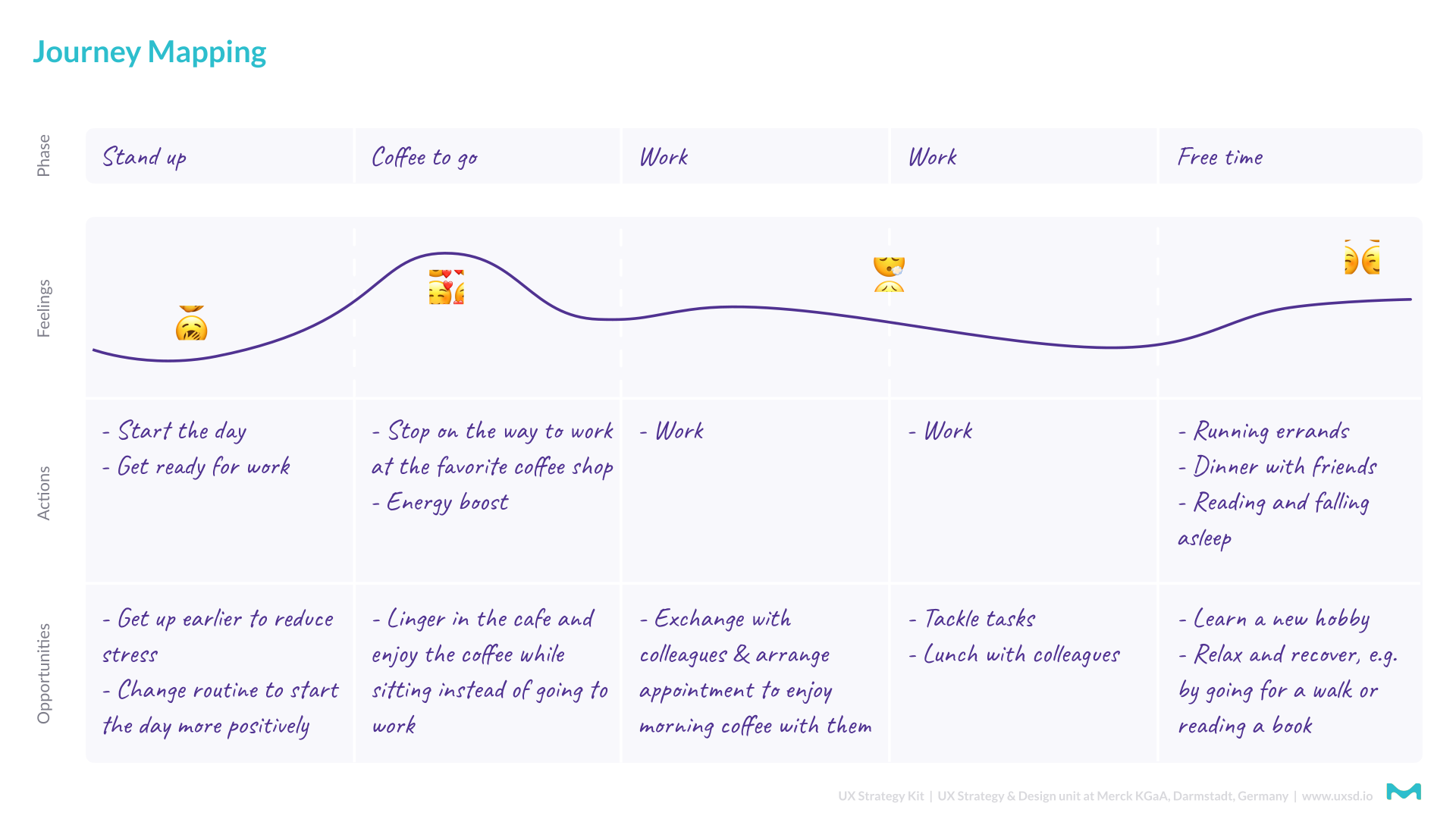
By letting the users visually map down a sequence or process or workflow, that already has been specified, this exercise allows you get a deep understanding of all sub-steps, possible issues, workarounds, and time connected to all efforts.
Step-by-step
  1. Prepare a large piece of paper and icon print outs for the quick visualization of sub-steps that can be used during the exercise. Participants can glue or pin down these icons at the respective positions on the time line.
  2. Clearly communicate the start, end, and point-of-view of the sequence. Try to reduce distractions by leaving out other processes that the users might think about but are not relevant to your research.
  3. Let the users write down the sequence in a very detailed way using the large piece of paper. All events that are being written down need to be at the correct position on the time line.
  4. Leave space for supplements or additions. Let your users draw arrows to connect different steps and describe how they relate to each other. Promote to use different colors to mark different levels of events or interactions.
  5. Ideally, you will end up with a very detailed visualization of the process you were looking at. It is important to read between the lines and to discover pain points that can potentially solved or lead to a problem statement.
What you need
  • Glue
  • Large paper
  • Paper
  • Pens
  • Stickers or icons
Do you have a question?
These methods might seem simple, but applying them in a real project is another story. We're there to help. If you have any questions, do not hesitate to get in touch with us at the User Experience Strategy & Design team.
Ask Away!
Explore similar methods
Mystery Shopping
Mystery Shopping observe
5+ Participants
3 h – 2 d

Observe people having a shopping experience in a store while observing and understanding their behaviour.

6 Thinking Hats
6 Thinking Hats observe
6+ Participants
45 – 90 min

Spot quality ideas after having generated a good amount of output.

AEIOU Framework
AEIOU Framework observe
1+ Participants
45 – 80 min

Give your observations and field research structure by getting to know the problem's environment.

Social Media Monitoring
Social Media Monitoring observe
1+ Participants
weeks – months

Compute the value of a brand or company.

Empathy Map
Empathy Map observe
1+ Participants
45 – 90 min

Collect information about how the emotional and mental world of your user looks like.

© Merck KGaA, Darmstadt, Germany, 2026.
Follow us
  • Dribbble
  • Instagram
  • Medium
  • Behance
Categories
  • Strategize
  • Observe
  • Ideate
  • Validate
  • Warm-up
Learn more
  • About Us
  • User Experience Strategy & Design
  • Liquid Design System
Legal
  • Data Privacy
  • Terms and Conditions
  • Imprint
  • Cookie Settings
Follow us
  • Dribbble
  • Instagram
  • Medium
  • Behance

We use cookies to improve your experience. Learn more